I have decided to move my blogging habit elsewhere (and hopefully revitalize it in the process). From now on, my personal blog page will have its own domain: bearwithfoolishness.com. If you still wish to follow, scroll to the bottom on that page and you'll find a subscribe box where you can enter your email address.
It is my intention in the coming weeks and months to be writing a bit more frequently, generally about topics I am reading and researching—most recently about the sixteenth and
seventeenth century debates over the extent of the atonement, for a class. But in keeping with the intention of this site all along, I hope to write at least as much on broader theological issues than just what I am researching. See you there!
Monday, July 8, 2013

Tuesday, June 4, 2013
Monday, January 14, 2013
Defining the Cross
I've been reading a lot about the atonement over the past few months, and keeping a research journal in which I write my thoughts and reactions to what I read. (It just hit 50 pages yesterday!) At times the tone of it becomes more devotional than scholarly, and that felt particularly true this morning. I tried to distill my thoughts down to a compact definition, on which I would then expand. It's incomplete and at times the paragraphs are disjointed from each other (such is often the case in these research journals), but I felt like sharing what was for me a source of profound wonder and awe at the love and goodness of God:
This is why Jesus was put to death in the economy of God’s salvation: so that our old humanity—the flesh, subject to the power of Sin and Death—would be destroyed, so that sins could therefore be justly forgiven among those who share in that death,* and so that the new humanity of Jesus’ risen life would be manifested in its place by the Spirit, and the new creation begin.
All that Jesus has accomplished may be placed within this definition without stretching it; on the contrary, the complexity and diversity of our descriptions ought to adorn this basic understanding.
In accomplishing this death upon the cross, Jesus is at once the substitute, representative, expiation, propitiation, ransom, victor, satisfaction, high priest, mercy seat, son of man & king of creation, image of God, savior, redeemer, mediator, servant, friend, son of David, passover lamb of God, glory of God, Word of God, wisdom and foolishness of God—Son of God.
This achievement constitutes the fulfillment of human destiny in the son of man—the long awaited kingdom of God, the reign of the Most High over all creation, has been inaugurated through the self-sacrificial love of the son of David, the king of the Jews, who rules the world as Word of God in his willingness to suffer and to forgive, entrusting himself to the power and faithfulness of God his Father over and against all of the evil, suffering, and darkness of the world and its powers. He is our true humanity, the humanity to which we are called, but which in our sin we have forsaken. Jesus is the death of our sins that commands our death to sin; he is the life that brings to light our life in him; he is our Prince and our pattern and our path; he is God’s word of forgiveness to us and the thwarting of every power over us that made forgiveness impossible. He is the very heart of God, the truth of who God is, hanging in weakness upon the torturous contrivances of our knowledge of good and evil and responding to our rebellion and rejection and self-assertion with nothing but “Father, forgive them, for they don’t know what they’re doing.”
I deem the plethora of titles and images with which we may adorn his precious name to be fitting—not because of the inexplicability of his accomplishment on the cross (as many a theologian of postmodern sympathies would argue) but because of the magnitude of what he has achieved. How can the profundity of this act, even if simply grasped and explicable to a child, ever be fathomed or ever be exhausted?*[fn: Justly, because forgiving them no longer entails a capitulation to and a perpetuation of the power of Sin.]
Tuesday, October 9, 2012
Luther's Insults
A friend shared a really funny website with me today: Luther's Insults. Imagine if theologians today still wrote these kinds of things...
Monday, September 24, 2012
So-Called "Gospel of Jesus' Wife" A Forgery?
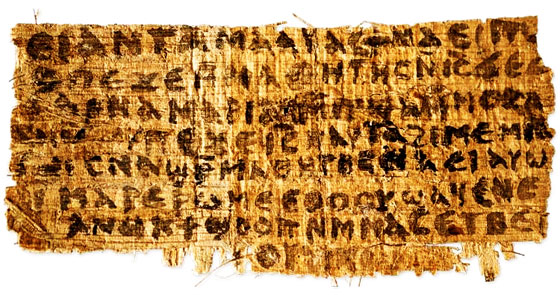
This is, of course, not making quite so many headlines.
On Mark Goodacre's blog some comments from Richard Bauckham (formerly of St. Andrews) are of note. He finds Watson's argument "very convincing":
It is of course quite possible that an ancient writer could have produced the text by this process of compilation from the Gospel of Thomas.... But what Watson's argument shows is how easy it would have been for a modern forger to produce this text. In my mind that combines with the other reasons for thinking this papyrus text is very suspicious, viz., the "Zeitgeist" and "too good to be true".... It is just too good to be true that this tiny fragment happens to preserve the words in which Jesus says "my wife" and thereby feeds into all the popular feeling about Jesus and Mary Magdalene that has been swirling around since at least the Da Vinci Code. The massive coverage of this new fragment in the press and on the internet is itself evidence for the "Zeitgeist" and "too good to be true" criteria for inauthenticity. Of course, we're only dealing in improbabilities. History being what it is, extraordinarily improbable coincidences do happen.Bauckham also makes an observation of note about the dating of the text:
It occurs to me we've missed something that Watson's argument really does demonstrate: that the text of this fragment (whether ancient or modern) was composed in Coptic, not translated from Greek. The Nag Hammadi Gospels and related texts were translated from Greek. So this is at best a late, not an early 'Gnostic" text, dependent on the Coptic version of Thomas. Not, therefore late 2nd century, as Karen King suggests.
Friday, September 21, 2012
Problems With Piper
In the past week I've been reading two books - one for a class, one for my own edification - and have found the interplay of the two in my thoughts both surprising and compelling. Or, more accurately, I've found it interesting to watch the ideas of one writer (as far as I understand them) bring unforeseen critique upon the other (as far as I understand him), in a way that I had never before considered.
The first book is John Piper's The Supremacy of God in Preaching. As far as Piper's books go, this one is more or less par for the course, in ways that are both good and bad. You have the deeply good and true conviction that the end of all things is God's glory; that humanity plays a part in this glory, a part that encompasses the totality of their being (but especially their affections and desires); that the task of sharing the word of God not only involves but is singularly devoted to impressing upon hearers the true greatness of majesty of God in such a way as evokes their reverence and awe and humble adoration.
On the other hand, you have the usual difficulties with Piper that stem from his attempt to situate any and every biblical idea within his own scheme of "Christian hedonism" - for example, a totally non-biblical definition of the concept, "the righteousness of God"; the reduction of authentic spirituality to certain feelings about God in apparent opposition to actions taken in obedience to God; also the myopic focus on individual spirituality which follows from this reduction. (One is left wondering, at times, what really distinguishes some of Piper's views from the German liberal Adolf von Harnack's diminishment of Christianity's "essence" to the solitary interplay of "God and the soul, the soul and its God.")
My interest is not so much in this particular book by Piper as it is with Piper's scheme of thought more broadly. I used to be quite enamored of our Baptist brother from Minnesota, embracing his scheme of "Christian hedonism" more or less wholesale, believing that it offered a wonderful freedom to Christians who were perhaps inclined to see their deepest desires and God's glory as being at odds with one another. This, he shows, is manifestly untrue. "God is most glorified in us when we are most satisfied in him" is the continual refrain of Piper's book Desiring God: Meditations of a Christian Hedonist, and at least at the time, I fully agreed with him.
But this pairing of superlatives (God is most glorified when we are most satisfied) is markedly incomplete. As I said, this is a myopic outlook on God's glory - it centers in on one thing and one thing only, the individual interiority in its apprehension of God, and situates the glory of God there, in radically exclusive terms. No wonder Piper speaks very little in Desiring God (or in The Supremacy of God in Preaching, or in most of his other books for that matter) about the Christian community, about the corporate context to which Paul is speaking when he talks about "Christ in you [plural] the hope of glory" (Col. 1:27). His vision of what is the core of the Christian life can never make the (I would say irreducibly) collective dimensions of that life anything other than incidental. Worse still, the exclusivity of this pairing of God's glory with my emotions has the ultimate effect of generating an all-consuming concern, not with God himself, nor with the neighbor whom I am to love in God's name, but with how I myself "feel" about God. If the be-all and end-all of Christian life is God's glory through my satisfaction in him, it seems that my sense of satisfaction cannot but become the center of my attention, because all else depends on it.
And this is where the other book I've been reading this past week becomes relevant. The second book is Dietrich Bonhoeffer's Ethics. Though the book remains incomplete in its final form (Bonhoeffer died before he could finish it), I am certain that it is nonetheless to be counted among the most significant theological works of the twentieth century. Particularly the first chapter, with its opening punch to the ethical gut of the modern man ("The knowledge of good and evil seems to be the aim of all ethical reflection. The first task of Christian ethics is to invalidate this knowledge."), issues a challenge to all human thinking and acting in the world, but not least to presumptuous Christians with a penchant for fabricating their own legalistic structures of piety. At the heart of Bonhoeffer's understanding of the ethical life lies the conviction that "the good" is not something the human mind is capable of apprehending apart from the revealed knowledge of God, because any form of knowledge, however noble and admirable, which does not recognize everything that "is" to be what it is within the unity of knowledge that is God the creator, is (a) fundamentally out of touch with reality, and (b) a reflection of my mastery over existence by my own intuition and understanding, rather than an acknowledgment of the dependency of all things on God for definition and direction.
In connection with this, Bonhoeffer warns away the attempt of Christians to "know their goodness," particularly by constructing a conscious scheme within which they might perceive how fully and successfully they honor their God. There is, for Bonhoeffer, one thing and one thing only when it comes to being in a right relationship with God: accepting the love of God in Jesus Christ, and choosing to "know thyself" only and ever only as one who is, at base, "chosen and loved by God" (we could say, 'justified by faith'). Within this secure self-knowledge which is really just one aspect of our broader knowledge of God, we become hearers and doers of God's word, and we become shameless in our doing of it - that is to say, our repeated question is not "what is the principle for which I must strive, that forms the basis of God's glory in my life, and of which I must continually fear falling short?" Rather, knowing ourselves to be totally accepted in Christ already, we then ask, "What is the will of God?" and we do it as it becomes clear to us, not giving thought to standards, schemes, and measures that might try to evaluate the purity of our action or intention. Within this picture Bonhoeffer includes the love of God - his love for us in Jesus Christ, the very same love that becomes our own as we receive it and respond to it in faith. To love God and others, for Bonhoeffer, is to think, feel, and act out of our acceptance of God's love for man in Jesus Christ, not simply to "reply" to God with some separate and independent love of our own, whose quality we are wont to measure and tweak and tend and keep.
Bonhoeffer's picture, even of the Christian's affections, centers in on God's lordship over us through Jesus Christ, and our apprehension of that lordship as the ground of all our affections. In contrast with this, Piper confuses God's lordship over us with our affections. In his scheme of "Christian hedonism," what occupies center stage is not the Lord of lords himself, but my emotions about this lord; accordingly, this scheme in practice has more to do with my lordship (my mastery over my emotions about God, who will not be glorified unless I feel really, really, really, really good about him all the time, and who is being horrendously dishonored if I feel anything less) than it does with God's. For all his knocking of Immanuel Kant (whose view of the matter he misunderstands, incidentally), Piper's "ethic" of the Christian life is every bit as duty-based and liable to enslave, even if Piper is able to make convenient additions about how God forgives our failure and how the Holy Spirit empowers our affections by grace.
To illustrate, let's consider how this plays out within the act of worship. In the days of my enthusiasm for Christian hedonism, I became increasingly concerned with the degree to which I found God desirable during church services. That, after all, seemed to be the "objective," in light of what Piper was saying. Now of course, one finds that the quickest way to obliterate an emotion is by focusing all attention on the emotion itself. (C.S. Lewis said something like this about anger, I think?) Many a worship service, therefore, became a wrestling match, an all-out war for my attention in which I was held in suspension between the awareness of two realities, both of which drew my attention, ironically, away from the God I was worshiping: (1) that I could only feel emotional about God if all my attention was fixed on him, and (2) that deficiency in such emotions amounted to dishonoring God. The nagging sense of these twin realities would turn many a worship service into a frantic, affective triage. What seemed at first glance like freedom became, instead, slavery.
Bonhoeffer invites us to something different. His proposal does not have fundamentally to do with our affective capacities, but delves deeper into that on which all our affections should be situated: the knowledge of God, and the knowing of all things only "in him." God is not most glorified in us when we are most satisfied in him - he is most glorified in us when we forsake the knowing of good and evil that is involved in scrutinizing whether our love for him is satisfying, and take hold of his love for us in Jesus Christ, knowing ourselves and all our feeble affections only within that love that embraces us no matter how we are feeling at present. Our self-awareness in worship then becomes a way of being aware of God and his goodness and his grace. And, wonderfully enough, the issue of this awareness is thankfulness and gratitude to God (something, incidentally, that Piper lambastes as a driving force for religious affection in Brothers, We Are Not Professionals), and this in turn issues in joy - the joy of knowing this God's unfathomable love, and of knowing myself and all my affections within that love, needing to do nothing to earn or obtain it, capable of doing nothing to magnify or diminish it. This kind of self-awareness, the self-awareness of the justified man, readily widens itself out to include others - not only I, but we, the justified, adopted and loved children of God, worship the one who loved us and freed us by his blood, contrary to the muddle of affections (to say nothing of our other sins and flaws) in which we daily live out our lives. How true and how freeing is this love, and how much more evocative of my delight than a distracting preoccupation with my emotions about God, needlessly endured because of my ignorance of the antecedent reality of God's incorruptible glory in the acceptance of sinners (such as myself, however I feel) in Jesus Christ!
Maybe Piper would agree with everything I just said. But the point is, whatever his intentions, I fear that people will (as I did) put down Desiring God with the impression that their own emotions and experience of God rather than God himself occupy pride of place in the Christian life. Surely this is not what Piper intends, but it is nevertheless where I feel his emphases (at least in his book) incline us. For Bonhoeffer, a maxim like "God is most glorified in us when we are most satisfied in him" would be inherently dangerous if it were meant in any way to constitute a directive for our spiritual lives - such maxims pose the danger of demanding of us an ongoing self-reliance whereby we differentiate ourselves tirelessly from ourselves again and again, scrutinizing our emotions and actions to determine by our judgment whether they are pleasing to God. We quite simply do not need schemes and principles such as this, because the business of our lives as Christians is not to take the temperature of our emotions and flagellate ourselves according to their deficiency (as Piper revels in doing, it seems, in a number of his books), but to know that we are loved by God in such a way as delves far beneath our temporary abilities and inabilities to feel a certain way about him. His acceptance, his love, and his glory are equally often magnified, it seems, in that he embraces us and draws us near to himself in spite of what we feel, and does not allow the transience of our emotions to impede him.
Saturday, July 21, 2012
Thursday, July 19, 2012
Monday, July 16, 2012
Sermon on Ephesians 1:3-14
Yesterday I gave a sermon on the opening blessing in Ephesians. You can download it or listen to it in your browser by clicking on this link; or, to download it, right click and select 'Save As': http://www.allsouls.com/downloads/DavidWestfall7.15.12.mp3
Monday, April 16, 2012
Thoughts On "Justification" by Markus Barth
 Justification by Markus Barth
My rating: 4 of 5 stars
Markus Barth's book, though originally written in 1968 (and translated into English in 1971), comes across as new, fresh, and profoundly relevant. I would highly recommend it to all - not only those who are interested in the present debate on justification in Paul, but to anyone who would understand the doctrine better and its relationship to the whole of Christian faith. The book is well-written in an unconventional 'dramatic' format that can be read quickly (it is under a hundred pages) and, for that matter, devotionally.
One thing that this book demonstrates is that the so-called 'New Perspective on Paul,' is really not so new, nor is it an alternative to many of the traditionally-held views of protestants. Well before Dunn and Sanders, Barth is writing about justification as the supremely ecclesiological doctrine, focused on the unification of Jews & Gentiles (and by extension, men, women, and people of other races and different social strata) in the one Messiah who has given his life for all and incorporated all alike, by faith, into his righteousness. Coupled with this ecclesiological focus (at no point treated as an alternative to soteriology, as some recent treatments oddly seem to suggest), Barth also brings in a very robust pneumatology, stressing that the verdict given in Christ is then carried out in the transformation of human lives through a Spirit-led participation in and reflection of the righteousness of Christ.
The following are, I think, the best key insights offered by Barth in this little book:
1) Justification as Christological - My general impression has been that, in many protestant tellings, justification is all about the verdict given to the individual sinner, who is declared righteous in spite of his being a sinner (simul iustus et peccator). What happens in this courtroom setting is that Jesus steps in as a mediator, saying in effect, 'Judge, please pretend I did all those things that make this person guilty, and pretend he did all those things that make me righteous.' The merits and demerits are swapped, and the Christian is thus enabled to stand righteous before God, despite not being so empirically.
Barth gives us a different picture, one that I think is more fundamentally in line with the apostle Paul's teaching. Justification is a verdict rendered, first of all, not for the individual sinner, but for Christ, and rendered in the form of an event - namely, his resurrection from the dead, following his faithful death. In vindicating Jesus on Easter, God pronounced him to be "the righteous one," the one who was faithful and obedient where the rest of humanity was not. From the perspective of the sinner who is justified by faith, the verdict is not so much rendered 'anew' or 'separately,' as it is enjoyed "in Christ" as already having been given; if you are in Christ, his already-rendered verdict ("risen!"; "righteous!") is yours too. As a consequence, the Spirit that raised Christ from the dead and in so doing 'justified' him (Rom. 4:23-25; 8:11; 1 Cor. 6:11; 1 Tim. 3:16) now dwells within and does the same for the sinner, fashioning for him or her a new self, "created after the likeness of God in true righteousness and holiness" which is to be "put on" for the remainder of one's life (Eph. 4:20-24).
Thus, as so many Reformed thinkers back to Calvin have stressed, justification is experienced only in Christ and the righteousness in which we share is his - it is in this sense 'alien' - but not in the legally fictive way that some protestant interpretations have implied. The verdict is matched with an ontological reality, namely the receipt of the Holy Spirit, invading our sinful state with a new identity that replaces the old and puts the old to death. The 'alien righteousness' of Christ indeed does not become 'intrinsic' to the believer (at least not this side of the eschaton), but nonetheless comes to reside in the believer; the transfer of identity from the old to new, the old being crucified with Christ and the new raised to walk in newness of life with Christ, means a righteousness that is not simply pronounced, but applied. (Barth follows the forensic metaphor in his division of the justifying act into the 'giving of the verdict' and the 'carrying out of the sentence.')
2) God's Righteousness/Justice - The justifying act, Barth stresses, is the activity of God himself, in Christ, of reconciling the world to himself. It is not so much the execution of 'justice' in the sense of meting out punishment where it is due (thought this notion may well be contained in God's righteousness), but refers primarily to God's saving justice, God's righteousness in the sense found most strongly in the Psalms and in Isaiah - including, crucially, the idea of God's faithfulness, particularly to the covenant. God's righteousness is his saving activity, in fidelity to his own promises to Israel, of 'rectifying' his people, and with them the whole created order. Barth's presentation of the theme accomplishes what more recent interpreters (especially N.T. Wright) have wished to capture in the Pauline texts, without absolutizing a single aspect of this righteousness (as Wright seems to do with 'covenant faithfulness'). Also, Barth takes note of the importance of God's righteousness to theodicy, to the vindication of God himself in the light of his creation's rebellion. ('Will the creator let it all go to ruin? Will he simply immolate all of it in the fires of judgment? No! His saving righteousness has now been unveiled through the faithful death of Jesus of Nazareth for the whole world, through which he is reconciling all things to himself in heaven and on earth!')
3) Jesus' Faithfulness - Crucial to this scheme is the idea of Jesus' faithfulness to the will of God his Father, which obtains the verdict we enjoy in him. The righteousness and faithfulness of the creator God is met with the faithfulness and consequent righteousness of the Son of God, who sums up in himself both the faithfulness that was sought (and not found) from the creation, and the faithfulness of God to the creation. I am not quite certain as to whether or not Barth had a definite answer to the pistis Christou question in Paul's letters (to be translated as "faith in Christ" or "the faith/faithfulness of Christ"), but either way, his stress on the faithfulness of Jesus and its relationship to our justifying righteousness is 'faithful' to the Pauline texts. Beyond this, it is of immense personal importance to justified sinners such as myself (which is of course part of the reason Paul is writing about it to begin with!) - my standing before God is not grounded upon my own goodness or obedience, nor even for that matter on my own faith or faithfulness! Rather, it is the faithfulness of the Messiah, in whose faithfulness I participate by the Spirit. "Nevertheless I live; but not I - the Messiah lives in me! And the life I live now in the flesh I live in the faithfulness of the Son of God, who loved me and gave himself for me" (my translation; not to suggest this would be Barth's rendering).
These are just a few of the issues to which Markus Barth's book speaks, and more could be said. But to anyone interested in the doctrine of justification - particularly to those who need a breath of fresh air in an area often characterized by repetitive voices simply talking past each other - Justification should be a very welcome and edifying presentation.
Sunday, March 25, 2012
N.T. Wright, "How God Became King: Why We've All Misunderstood the Gospels"
N.T. Wright's lecture based on his book, How God Became King at Calvin College's 2012 January Series.
Wednesday, March 21, 2012
Review of "The Trinity and the Kingdom" by Jürgen Moltmann
 The Trinity and the Kingdom by Jürgen Moltmann
My rating: 3 of 5 stars
Moltmann's engagement with Trinitarian theology is highly thought-provoking. One thing I greatly appreciated was his insistence that, following the biblical writers, we must begin by talking about the threeness of God and then move toward oneness. In line with this, I think he successfully demonstrated the inadequacy of some western formulations of the trinity that consider it sufficient to say that the different persons all share the same 'divine substance,' as though this were all that mattered. (In my mind, this can tend toward tri-theism even more than Moltmann's 'social' model of the Trinity, since it doesn't lay enough stress on the mutual indwelling of the persons in one another - they are simply three beings that hold a certain attribute in common.) Perhaps the most engaging portion of the book is in its discussion of 'the passion of God,' i.e. the question of how the triune God of Christian confession relates to the problem of evil and suffering in the world. In keeping with his strong theology of the cross (best exemplified in his masterpiece, "The Crucified God"), Moltmann insists that we regard suffering love as intrinsic to the very identity of God, such that a creation in which the Son did not offer himself up to death would be inconceivable.
With reference to the title, Moltmann's book is 'heavy' on trinity and 'light' - extremely light - on kingdom. He doesn't even attempt sufficiently to ground his ideas within the ancient biblical concept of the kingdom of God; he simply uses the term as though it manifestly means what he thinks it does (which it manifestly doesn't, at least not if he intends to mean by it something like what the biblical writers of the second temple period meant by it). His general inattentiveness to the biblical text and ancient historical context at this point (as at others) is hampered further by his modern allergy to any hint of hierarchy whatsoever, which in my mind yields a skewed conception of the kingdom of God that demands we sweep large portions of the biblical text - both in the gospels and in the epistles, as well as vast swathes of the Old Testament - under the rug. In tracing the connections between a monarchical monotheism and human systems of oppression, he throws the baby out with the bathwater, assuming that the problem is with the notion of power and authority per se and not in our human perversion of them in disobedience to the good authority of a loving God. The great hope of the biblical writers seems to be that God would be acknowledged as king on earth as in heaven, and that his will would be done and the knowledge of him would be perfected; only the Reign of God, on earth as in heaven, could yield true creaturely freedom. (This latter point, in fairness, is something Moltmann recognizes - he acknowledges that true 'freedom' entails not only an openness of decision but specifically a willingness for the Good.)
Moltmann's ideal, however, leaves us with a God who is not a king but a friend (as though the two were mutually exclusive!). His argument depends on a softening of the biblical concepts of fatherhood and sonship, as well as a total ignoring of the idea of headship, such that he emerges with a totally egalitarian reading of the Trinity that seems to leave little room for Paul's affirmation, precisely on the point of authority and submission, that "the head of Christ is God" (1 Cor 11:3) and that the Son to whom all things have been subjected will himself be subjected to the Father in the age to come such that the God to whom all is subjected will at last be "all in all" (1 Cor 15:27-28). Where God's status as "all in all" for Moltmann entails something like Christian panentheism, for Paul it clearly means exactly what Moltmann, despite using his phrase, does not want it to mean - namely, that the entire created order is, at last, fully in unmediated submission to its Creator King. In the final analysis, Moltmann emerges with a picture of the age to come that, while interesting and certainly appealing to modern western liberal democrats, does not appear to resemble clearly the biblical picture of God become king in Jesus of Nazareth, and implementing his rule through the Holy Spirit.
Moltmann thus escapes a heterodox subordinationism, but ends up denying any form of hierarchy whatsoever within the Godhead in the process. The biblical witness speaks strongly otherwise; this needn't equate to hierarchical systems within the church as he fears, moreover, since 'monarchical monotheism' (as Moltmann calls it) is precisely the thing that is meant to keep hierarchical relationships in check (as with slaves and masters) because both slave and master, both husband and wife, both parent and child, and both Jew as the gospel's first recipient and Gentile as equal second are in every case equally answerable to the very same Lord and God over all. Slaves and masters alike have a Master in heaven; husbands and wives are all alike under the headship of the same Bridegroom; parents and children, Jews and Gentiles, are all alike the children of one heavenly Father. When God is all in all, there can be no oppression because this is not how he rules the world; domination between God's creatures suggests a lack of subjection to God the king, not a genuine recognition of him as such.
At this point, though, I've strayed more into philosophical differences with Moltmann than with anything wrong with the book. Apart from the imbalance between his discussion of the Trinity and of the Kingdom (with a particular dearth of textual engagement when it comes to the latter), this book is an excellent, engaging inquiry into perhaps the greatest mystery of the Christian faith, and I highly recommend it to anyone interested in the topic. If you are looking to delve into Moltmann for the first time, however, a better place to start would be "The Crucified God."
Tuesday, November 29, 2011
An Account of Early Church Worship
On the day called Sunday all who live in the cities or in the country gather at one place and the memoirs of the apostles or the writings of the prophets are read as long as time permits. When the reader has finished, the one who is presiding instructs us in a brief discourse and exhorts us to imitate these noble things. Then we all stand up together and offer prayers.... When we have finished the prayer, bread is brought forth, and wine and water, and the presiding minister offers up prayers and thanksgiving to the best of his ability, and the people assent, saying the Amen; after this the consecrated elements are distributed and received by each one. Then a deacon brings a portion to those who are absent. Those who prosper, and who so wish, contribute what each thinks fit. What is collected is deposited with the presiding minister who takes care of the orphans and widows, and those who are in need because of sickness or some other reason, and those who are imprisoned, and the strangers and sojourners among us.
From Justin Martyr's First Apology, quoted on pp. 28-29 of Wilken, Robert Louis. The Spirit of Early Christian Thought: Seeking the Face of God. Newhaven: Yale University Press, 2003.
I've been doing some research for a paper on Christology in the early Church, and came across this description of early Christian worship. It isn't directly related to my topic, but it captured my attention nonetheless and I thought I'd share it with you. This description of Christian worship comes to us out of the mid-second century (i.e., the 100s AD) from the hand of Justin Martyr, one of the first great Christian Apologists. (He was a philosopher, and continued wearing his scholarly garb after he converted to Christianity as a statement of his intent to articulate the gospel in a rationally coherent way in the presence of its skeptics and detractors.) I just wanted you to notice a few things about what he says:
1. First, notice the way in which the scriptures are handled: "and the memoirs of the apostles or the writings of the prophets [in other words, the New Testament or Old Testament writings] are read as long as time permits." The reading of scripture, in line with 1 Timothy 4:13, took on a central importance, and in the congregation of which Justin was a member at least, there was no definite limit on how long scripture might be read at a given worship service. We are probably talking about longer readings rather than shorter ones here, and this raises a worthwhile question: why don't we do this in the church today? Why do we so often read only what will be discussed in the sermon? (This can be especially catastrophic in some parts of the protestant tradition, where the sermon may for better or worse focus on only a couple of verses at a time.) Why not give people more rather than less, so that the diversity of situations out of which church attendees come can be addressed by many things from scripture, and not just the one topic a pastor wants to talk about?
2. Second, notice the twofold pattern of the preaching: instruction and exhortation. This is widely recognized in the church today, but it is helpful to point out the value of this simple approach to sermons. The sermon is intended to address listeners with the word of God, both informing them of and clarifying its meaning (or acknowledging obscurity and uncertainty where it exists), and applying it to them in such a way that the word will take root, grow, and bear fruit in their lives in whatever context or calling they find themselves in. A focus on instruction and exhortation in sermons will in the long run yield communities of Christian disciples who both understand and do the word of God.
3. Third, notice the importance of prayer. It is corporate, something done together, and comes in sequence after the reading of scripture and the sermon. This means that as the church is first addressed by the word of God, it is being prepared to respond with words of its own, based on its own needs that have been put in proper perspective by God's revelation of himself in the gospel. What does corporate prayer look like in your churches? Speaking for my own Anglican tradition, I've come to appreciate lately the value in allowing a significant amount of time for people to pray in the midst of the assembly as they feel led, so that a whole range of the church's needs gets addressed by the church herself. (The pitfall in my tradition is to omit this in the liturgical form of the prayers, so that corporate prayer ends up sounding much more like another segment of the announcements than it does the sweet, rising incense of petition, praise, and thanksgiving from a people to their God.)
4. Fourth, notice the centrality of the Eucharist (i.e., the Lord's Supper). As in the New Testament (cf. Acts 2:42-47; 1 Cor. 11:17-34), the celebration of the meal Jesus gave us was an absolutely indispensable part of Christian worship - one could say, it was the edible word that stood alongside the audible word, the sermon. For a multitude of historical reasons there isn't time to discuss right now, this practice has often been pushed to the margins in protestant worship especially (despite the insistence of reformers like John Calvin on its centrality to Christian worship). A church that is 'all pulpit and no table' is in a precarious position (as of course is a church that is 'all table and no pulpit'), in danger of forgetting the importance of experiencing and enjoying the life of the kingdom in intimate personal communion with Christ and with his body the church. This need challenges us, beyond the mere question of how often our churches 'do communion,' to ask ourselves whether our churches are places where life is truly being lived 'together' in a meaningful sense.
5. Fifth and finally, notice how giving in the church is closely connected with providing for the needs of its members, especially people who are poor or in bad health. This is an area in which many churches have gotten a bad reputation, as impersonal organizations that are more intent upon self-perpetuation and on getting fancier facilities or gadgets than they are on engaging in holistic ministry that seeks to address the practical everyday needs of its family members. I won't pretend to have any experience with the ordinary concerns of church budgeting, but what would it look like for the first item on the budgetary concerns of a church to be "orphans and widows, or those who are in need because of sickness or some other reason"? (The last phrase is deliberately vague - in other words, "fill in the blank!") Might churches actually find that, far from limiting resources for ministry and outreach, this kind of prioritization of financial resources might in the long run actually further the work of ministry, by turning a church into a tight-knit community that loves and cares for its members in a way that is utterly foreign to this world? It is better to have people attracted to churches, not because of the funds that those churches were able to sink into state of the art facilities or media, but because of the Christlike generosity of people whose love for one another was such that they didn't regard anything they had as their own, but only as a gift from God with which to serve others and the world. That's the kingdom springing up in the midst of the present evil age, and Christian generosity of every sort serves as one of the most vivid signposts of the reign of God that has been inaugurated in the world through Jesus Christ, who was generous to the point of giving us his very self, of becoming poor so that we through his poverty might become rich.
Anyway, just some thoughts. Hopefully you find Justin's account compelling!
Saturday, November 19, 2011
A God-Summary, Summarized
In him we have deliverance through his blood—the forgiveness of trespasses—based on the great riches of his grace, which he’s made to overflow abundantly to us in the form of every kind of wisdom and insight, just as he has made the mystery of his will known to us, based on his purpose that he publicly displayed in Christ. This was a divine plan for the fullness of the times, to ‘sum up’ all things in Christ—things in the heavens and things on the earth, in him.
Ephesians 1:7-10
I was reading Ephesians and felt the need to share my sense of wonder. Paul says that in Christ, God “publicly displayed his purpose” (Eph. 1:9). This mirrors similar language in Romans 3, where Paul tells us that God “publicly displayed” Christ as “an atoning sacrifice accessible by faith, in order to display God’s righteousness” (v. 25). And what is this purpose? It is “a divine plan for the fullness of the times, to ‘sum up’ all things in Christ—things in the heavens and things on the earth, in him” (Eph. 1:10). Moreover, this purpose was specially displayed to us, to sinners who have received the gospel. His abounding grace, Paul says, has overflowed to us not least in the fact that he’s revealed to us this mystery of his will for the world in Christ. So my question is, do you in fact look at the world around you as it is “in Christ”? If God’s purpose is to “sum up” everything in this universe in Jesus Christ (anakephalaiosasthai—literally, to ‘put under the heading of’), are we endeavoring to regard it in the light of that purpose?
This claim is astonishing enough already, without much further comment. A human being, in whose identity the whole creation is supposed to be somehow contained? What sort of a person is this?! The truth is, this man is the image of the invisible God, the firstborn over all creation (Col. 1:10), the one whom the whole fullness of deity inhabits bodily (2:9). He is the true son of God where Adam failed to be—true because he is not simply son of God, but God the Son, utterly obedient to the will of his Father where all else have gone astray. The universe was made for his lordship, his headship.
And look at how he exercises that lordship, that headship. How and where do we find all things summed up in Christ, revealed most truly for what they are in him? We come to a cross, to a bloody instrument of torture, to which this man has been affixed—by the very creatures whom God made through him and commanded to represent him in the creation! What sort of a God is this, who accepts crucifixion from the hands of his creatures? What sort of a man is this, who perishes under the weight of evil, the only words on his lips “Father, forgive them…” and “My God, my God, why have your forsaken me?” This is the identity of our God, most truly displayed! This is God joining us in our god-forsakenness, our godlessness, being for the world that which you and I have refused to be—God's image, God's glory, God's loving presence.
At the cross, we find the prolepsis of what Paul is talking about in Ephesians 1:10, the Son of God bearing all things within himself: all the world’s evil, all the world’s shame, all the world’s guilt, and all the world’s violence—and emerging victorious from the empty tomb, drawing with him all those who have faith in God into newness of his life, and all those who do not into the eternal judgment of death, the final fruition of their tireless efforts to be god for themselves. Thus the cross is the propitiation for the sins of the whole world, the place where God’s judgment against the world is unveiled and carried out. Yet by bearing it in himself, Jesus made this self-sacrificial act the most fundamental expression of God’s identity to the creation. (Truly, he is the image of the invisible God!) God has said to the world, in the crucified and risen Messiah, ‘I WILL BE WHAT I WILL BE, over and against all of your violence and blasphemy, your efforts to make yourselves god and to usurp my creation to suit your own ends; yet I will give you the same life I intend to offer the whole creation, if you will turn from your rebellion and share in my suffering.’
That is our God, friends. I don’t really have any comment of my own on to add on the matter, just an irrepressible need to share my astonishment.
Saturday, October 22, 2011
Sermon on Romans 11
I promised audio a while back for the sermon I gave in August - Here it is! http://www.allsouls.com/downloads/DavidWestfall8.14.11.mp3
Tuesday, August 16, 2011
Praying and Resting
The mind that comes to rest is tended
In ways that it cannot intend:
Is borne, preserved, and comprehended
By what it cannot comprehend.
Your Sabbath, Lord, thus keeps us by
Your will, not ours. And it is fit
Our only choice should be to die
Into that rest, or out of it.
-Wendell Berry, “Another Sunday Morning Comes” (1979)
Over the past few weeks, I’ve been thinking a great deal about the finished work of Christ—how he, by his work on the cross, has already done everything necessary to affect the restoration of our fellowship with God—and consequently how our lives must be characterized by a certain striving, not one that chases after God’s promises to us seeking to grab hold of them, but instead that rests—a striving that rests, that is—in faith, with an utter reliance upon what has been done already, and upon what will be done in the future, when Christ returns.
I’ve been writing a book (tentatively titled Between the Two Appearings) that expounds on Titus 2:11-14, where the Apostle Paul situates all Christian living and striving within a certain timeline, with the finished work of our Savior behind us, and his work yet to be completed ahead of us. Meanwhile I had been preparing a sermon on Romans 11 that I preached this past Sunday (audio will be forthcoming), in which Paul gets at the question of Israel’s continuing disobedience with a sustained look at God himself—at the creator’s sovereign purposes, in history, to consign everything to disobedience, in order that he may have mercy on it (Rom. 11:32). All that while I’d also been reading Michael Horton’s Christless Christianity: The Alternative Gospel of the American Church, which criticizes the tendency in American Protestantism (both liberal and conservative) to eschew the preaching of gospel (the person and work of Christ) in favor of law (what we ought to do to be good, relevant, socially-conscious Christians). To that, add reading Flannery O’Connor’s novel, Wise Blood, in which the character Hazel Motes preaches a “Church Without Christ” (ironically in reaction against what he assumes to be the ‘real’ gospel, which is in fact the Christless Christianity Horton is talking about!), and you’ll be able to see why my recent reflections have been devoted rather exclusively to a single idea, the centrality of Jesus Christ. The purpose of this reflection, though, is not to enumerate all of these reflections, but to focus on one in particular, that I think is of great importance to any one of us: prayer.
For some years now, I have been fairly consistent in following a particular pattern of Christian devotion, that of the Daily Office found in The Book of Common Prayer. (Perhaps you’ve heard this practice referred to by a different name: Daily Prayer, Matins and Evensong, the Divine Office, etc.) In my Anglican tradition, a very precise and rich liturgy determines most of our worship, both communally and often individually as well. At certain times of day—as many as four, usually no fewer than two—a group or an individual may read through the daily prayers in the prayer book, following the format and adding their own personal prayers where appropriate.
As with all spiritual disciplines and practices, this one can be misused—something I realized I’d been doing for who knows how long. It can become a work, a pattern of obedience by which I believe myself to be maintaining my relationship with God through my own action and initiative; if I am negligent—tired and not very attentive one evening, say, or I miss a few times during the week—this may displease him, but if I am diligent, he’ll be very happy and so will I. Of course, if you’d asked me about that danger I wouldn’t have said such things—my fellowship with God is a gift of grace! But had I really believed that, I should not have been feeling guilty when my attention was more prone to wander today, whereas I really prayed good ‘n hard with plenty of feeling and eagerness yesterday.
So as I was reading and writing and thinking about this matter—the objective center of the gospel, this man of Calvary now out of his tomb—I found myself laying the Daily Office aside, and simply pondering daily the mighty work that Christ had accomplished for our sakes, then praying for my needs and those of others I know. The fervency with which I did this varied every bit as much as it did when I prayed the Office, but my feelings were no longer uncertain, the face of God never obscured by the subjectivity of my circumstance. For I had just glimpsed—whether for a long time or a short time, whether with tears or with joy, whether I was tired or wide awake—the agony of a God of self-giving love upon a bloody cross, who I knew in that very moment of prayer embraced me and still embraces me within his very self, hidden in God until his glorious appearing (Col. 3:3-4). I found this to be the anchor of my soul, limiting, as anchors do, the distance that I might otherwise travel in any direction away from the rock-bottom certainty that in Christ, God is utterly, impossibly, irrevocably for me.
Now I hope that touches your heart, because here is the point: I’ve stumbled clumsily across a method of prayer that I think all of us would do well to emulate in one way or another, whatever our particular tradition might be. My temporary vacation from the prayer book has reminded me of what must lie at the heart of all our prayers: Almighty God, glorified in the person and work of Christ, on whom we fix our eyes and to whom we hold fast by the power of the Holy Spirit. If the celebration of this God and what he has done does not have primacy, I am convinced that our praying, our ‘quiet times,’ our disciplines of any kind will inevitably incline more and more toward selfishness, toward self-reliance, and consequently to anxiety.
I say “temporary vacation” from the prayer book because I eventually discovered, to my astonishment, that this is exactly what the Daily Office does—I hadn’t been able to realize it until I’d taken a step back from what I thought I understood! The prayers begin with readings from the scriptures, celebrates the gospel through the songs of Luke, which are assigned to different times of day (Lk. 1:68-79 AM; vv. 46-55 PM; 2:29-32 before bed—try it!), recites the Apostle’s Creed and the Lord’s Prayer, and concludes with the various prayers and petitions that the group or individual may have. The name “Daily Office,” a translation of the Latin name for it that we might otherwise render “Daily Duty” creates a misleading impression of what the purpose of the prayers actually is: to center those who pray them around a God of grace and glory and righteousness, revealed through Jesus Christ for all who have faith in him, a God before whom we may therefore be utterly confident in Christ.
I say this not to advertise the prayer book itself (though I would recommend it to many), but instead to ‘advertise’ what I have found to be of the utmost importance, whatever form our prayers take. The gospel of Jesus Christ—the good news that God has vindicated Jesus of Nazareth, crucified for the sins of the world, by raising him from the dead and enthroning him over all creation—must take the center stage in all of our praying and thinking about God, because we understand the identity of God himself nowhere so truly as in this event: Jesus crucified, lifted up upon an instrument of torture, giving himself in total love for his enemies and drawing all the world to himself (Jn. 12:32-33). Knowing this, and knowing yourself to be such a one, drawn to this bleeding God of love in spite of your rebellion, means knowing peace, joy, and confidence of a kind that no power or principality can thwart.
As I’ve reflected on these things, I’ve also been reading poetry by Wendell Berry. The last two stanzas of one of his pieces is quoted above, taken from a series of “Sabbath Poems,” all of which address the topic of rest in one way or another. It occurred to me that Berry’s picture of the mind that comes to rest, that has rested from its works by trusting in the gospel of God’s grace (Heb. 4:9-11) and is subsequently cared for and preserved in ways that it cannot even fathom, is a picture of exactly the sort of mindset I am talking about with regard to prayer. Read the stanzas: when it comes to your devotions, your quiet times, or whatever you may call them, do you believe that you are doing something with God, or that God is doing something with you? Your task is not to mount up to God and grab a hold of his arms when you pray, but to see his arms already open to you upon the cross, and then as Berry says, “to die into that rest”—to know yourself crucified with the Messiah but consequently alive to God, as the Messiah is, and resting in what Christ has already accomplished.
Saturday, July 16, 2011
Discerning the Body in Worship
In Christian gatherings and in private Christian devotion, there is a tendency to focus and attend on the unseen, perhaps in a fairly exclusive manner. I don’t want to be too harsh on the idea—after all, do we not worship that which is unseen? “Who hopes for what he sees?” Not only do I not wish to denigrate the needed Christian preoccupation with that which lies beyond the senses, beyond the empirical realm (in a world that often displays little ability to envision anything more than this), it is my ardent desire to see Christians develop a heightened ability to attend upon the presence—and the unfathomable glory—of the invisible, living God, particularly at gathered worship.
But this is related to my complaint. Attending upon God at gathered worship does not necessarily mean closing one’s eyes, waving one’s hands, and drawing one’s mind to the one-on-one, ‘me and my God’ exchange taking place. (Not that I have any problem with eye-closing per se… but do you ever close your eyes to listen not only to your voice, but to a multitude of voices, praising God’s name “with one accord”?) Rather than a basically dualistic dichotomization of the spiritual and the immediately material, would not the church benefit from having eyes to see the Spirit of God also at work precisely in the visible ‘worship event’? We have a whole host of ways of describing how God is present, immanent within his world despite the world’s refusal to know and worship him—but then, is not the presence of a worshiping community, one that is visible to all alike, exactly one such means of God’s immanence? If we are the Spirit-constituted body of the Messiah, then we are the visible sign to the world, to the rulers, to the principalities and powers, that a different lord runs the world, and one who is present in it at that. Christian worship, then, is not meant to invite us only into an invisible encounter with God, but also into a recognition of the display of that God’s glory in the midst of the visible people of God, gathered in the name of their risen lord.
As an Anglican, I think (hopefully without any hint of pride in my tradition or condescension toward others) that I see this vividly displayed when we gather for Sunday worship, in a way that is perhaps missed in some worshiping communities whose philosophies about liturgy are more truncated. (Mind you, every church has a liturgy, whether they realize this or not—they have some modus operandi when it comes to worship services that is generally consistent at every gathering and reflects a particular attitude toward what Christian worship is meant to be.) The liturgy—with or without all the ‘smells and bells’ that one finds in many Anglican churches—is all about facilitating a direct, Spirit-led encounter between God and his people, understood as a collective whole. One is free to ‘keep one’s eyes open,’ as it were, to what is going on all around, to the delicate interplay of the visible with the invisible. What do I see at a ‘typical’ (I use the word cautiously) service in my tradition? I see the people of God, enjoying the presence of God, and am myself taken up into this marvelous event: worshiping his name through song, listening to his word being read, professing our shared faith through the creed, confessing our sins together, and going to the Lord’s table as one, to celebrate our identity as the already-but-not-yet-raised-from-the-dead Body of Christ.
This idea of discerning the invisible in the visible shows up in remarkable ways in scripture, and I’ll focus on one instance in particular: in 1 Corinthians 11 Paul writes, “Whoever eats and drinks without recognizing the Body eats and drinks judgment on himself” (v. 29). For centuries this has been co-opted by various people in the interminable debates about the mode of Christ’s presence in the Lord’s Supper, but increasingly today it is recognized among scholars and interpreters that Paul’s point here has to do not with the invisible presence of Jesus ‘in the bread’ and ‘in the wine’, but rather with his presence at the supper, his presence among the gathered community—that is, the Body. If one does not attend in the slightest to the reality of this Body in worship—as the Corinthians were failing to do, “each one going ahead with his own meal”—true worship is not being offered. To 'discern the Body,' especially in the Lord’s supper, is to recognize the unique presence of God among a Spirit-constituted, called-out people, and to welcome his presence there whenever this people is gathered for worship.
This is not to say that most evangelicals are facing condemnation or are failing to offer true worship. Who among us doesn’t know the great joy of gathering in a room full of people and praising the name of God together? I am saying, simply, that the truly remarkable, visible reality when the people of God are gathered in the name of Jesus is something we haven’t devoted enough attention to, and it ought to be a part of our imaginative landscape when we approach God in worship week by week. In our emphasis on the unseen in worship, we are sometimes tempted to operate with a conception of the worshiping church as a constellation of tenuously-connected individuals whose worship, vertically speaking, may be quite attuned, but equally may often be, horizontally, quite disconnected. Food for your thought, next time you worship: the Spirit has gathered these people as living members of Jesus’ body, and you have been gathered with them; God walks among you (2 Cor. 6:16), and part of having no good apart from God is seeing “the saints in the land, the excellent ones, in whom is all my delight” (Ps. 16:1-2). It doesn't mean you should be worshiping them—it just means you should be worshiping with them.
Thursday, June 23, 2011
Getting the Big Picture Straight
One of the main things that reading a lot of Lesslie Newbigin, N.T. Wright, and Stanley Hauerwas has done for me is remind me of the vast importance of narrative, not only in scripture and theology, but also in everyday Christian life. Fundamental to a biblical worldview is the idea of a 'controlling narrative,' an overarching story of the creator God and his creation, one that accounts - historically, factually - for the state of the world as it is today and for the direction in which this world is headed. Additionally, the more I've thought about this controlling narrative, the more I've become convinced that most of us Christians simply aren't living in it consciously. We tend to imbibe the lessons of our culture, which has a very strong, very distinct narrative of its own (though its manifestations may differ in certain situations). It is a narrative of progress (social, technological, moral), of capitalistic enterprise (the accumulation of material wealth amounting to the happy and fulfilling life), of postmodern pluralism (the easing of distinctives and softening of moral absolutes leading to a moral landscape devoid of anything imposing or infringing on individual preferences), and so forth. A cultural narrative like this actually has its place within the grand narrative of scripture - it is a feature of the "present evil age" (Gal. 1:4), a mirage cast up by the powers and principalities over this present darkness (Eph. 6:12). It is a deluded misdirection of true human purpose, one that can only terminate in death.
As I've thought about this competition of narratives, it seems to me that part of our problem is that we are reading scripture without the necessary paradigm shift involved in absorbing its distinctive narrative and situating all others within it. We need aids, helps of some kind, that can give us a compass to help orient us as we read scripture and try to see the world in its light. Toward that end, I've been working on a (very rough) systematic outline of the biblical meta-narrative, which I now present to you in the hope that it may 'polish the lenses' a bit in your reading of scripture. It is both systematic and narratival in form, so that the whole of Christian theology may be fitted somewhere into its structure. What is more, the outline is such that one ought to be able to read any part of the bible and attach it to one of the headings. Even in the past couple of weeks, I have found that having something like this in my mind as I read the bible gives me a sense not only of where I am in salvation history, but where it's all going and why it matters. So, here is the outline - afterward, I'll include some further notes on it:
==========
Salvation History
Chapter 1: Adam
- God creates & commissions humanity (Adam) to be a blessing to the world and wisely rule over it as his image-bearers.
- Adam (& all humanity) fails in that commission, choosing unfaithfulness instead by distrusting God and seeking to take wisdom, knowledge, and immortality for themselves apart from him; this brings upon humanity (in Adam) the curse of exile from Eden, and leaves them bound by the forces of sin, death, and the Devil.
- God promises that through humanity he would eventually defeat and destroy sin, death, and the devil, and in effect that humanity’s long exile from paradise would end; this is fulfilled through the second Adam, Jesus of Nazareth.
Chapter 2: Abraham
- God sets apart Abraham and his offspring (Israel) to be a special, chosen people through whom this promise to Adam for the whole world would be carried out - a new humanity in which God's original intention for the creation would be fulfilled; he promises them blessing, growth, and a land of their own (Palestine).
- Israel enters into slavery in Egypt, and for centuries expectantly awaits the fulfillment of God’s promises.
- God redeems his people from slavery in Egypt, and leads them through the Red Sea and wilderness into the Promised Land.
Chapter 3: Israel
- God gives Israel a law (Torah) that is to regulate all their social, personal, and religious affairs, and to serve as the blueprint for their life as a holy people bringing Abraham’s blessing to the whole earth.
- Israel fails in that commission, choosing unfaithfulness instead by worshiping other gods; they fail to obey the Torah and establish the holy society that God commanded, bringing upon themselves the curse of exile (which recapitulates the curse and exile of Adam).
- God promises an end to their exile, not only in geographic terms but also in spiritual terms (i.e., to end the spiritual reality of Adam’s sin in which Israel is also enslaved). This promise is to come through a Messiah, who will bring God's kingdom and draw all the nations of the earth to himself.
Chapter 4: Jesus
- God sets apart Jesus and his followers (Jew & Gentile alike) to be the renewed Israel - a special, chosen people through whom his promises will be carried out, a new humanity in which his original intention for the creation would be fulfilled; among them and in Jesus God brings the long-awaited the fulfillment of his promises: the end of exile (for Adam and Israel alike), the coming of the kingdom of God, a new heart/nature through the Spirit, resurrection from the dead, the life of the coming age, the defeat of sin, death, and the Devil.
- Jesus is obedient to the will of God where both Adam and Israel failed, and in perfect faithfulness lives the true human life to which both had been called, defeats the forces of Satan, overcomes temptation, and offers himself freely upon the cross for the sins of his people.
- God vindicates Jesus by raising him from the dead, and in Jesus redeems for himself a new humanity whose Adamic nature has been crucified with the Messiah, who possess a new heart/nature through the Holy Spirit, whose exile is ended (citizenship in God’s kingdom), and who in the coming age (resurrection) fulfill God’s original intention for the whole creation.
==========
Notes:
I tried to structure this very consistently, and you'll notice the clear pattern in each 'chapter.'
1. God acts/commissions
2. Humanity fails (until Jesus)
3. God makes a promise and redeems
Also notice the fundamental sweep of scripture in terms of the story of the human race. It is like this:
Adam --> Israel --> Jesus
Scripture is, at its heart, a narrative about God's redemptive purposes with the human race, not a lapidary history of tenuously-connected events. (Perhaps some of the ways of reading scripture that have been influential since the medieval period have gotten us off track here, particularly in how we read the Old Testament.) Adam was given a commission as God's image-bearer, and the fulfillment of it is what all of human history has headed towards: the enthronement of Christ, the true image of God (Col. 1:10) over all things (Eph. 1:10), with redeemed humanity in him serving as rulers over the new creation. When Adam failed, God elected Israel to be the people through whom this purpose would be carried forward; their observance of Torah was not for the purpose of arbitrarily fulfilling God's standards of uprightness, but in order to be the holy people of a holy God, a light to all the nations and the source of YHWH's blessing to all the earth (as he promised Abraham, Gen. 12:3). But like Adam, Israel failed and needed to be rescued as well, since they shared in the same fundamental problem as Adam - the curse of sin and death, and exile from perfect fellowship with God. (This was recapitulated in the Babylonian exile - just as Adam was "east of Eden," so Israel was "east of Jerusalem.") Jesus is the direct answer to this problem: as Messiah he actually embodies Israel (see how this plays out in the servant songs of Isaiah 42-55), and by his life, death, resurrection and enthronement as the vindicated Son of Man (Dan. 7:13&14) he atones for the sins of his people and rises to rule all the nations (Rom. 15:12, quoting Isa. 11:10).
Paul sums it up quite well with these verses:
- With regard to Adam. "For as by a man came death, by a man has come also the resurrection of the dead. For as in Adam all die, so also in Christ shall all be made alive" (1 Cor. 15:20-21).
- With regard to Israel. "For I tell you that Christ became a servant to the circumcision to show God's truthfulness, in order to confirm the promises given to the patriarchs, and in order that the Gentiles might glorify God for his mercy" (Rom. 15:8&9).
...
Friends, maybe this all seems rather dense, and maybe I seem like more of a history nerd than anything else, but when I think of God's purposes for this world and how perfectly they are testified in scripture as part of one flawless uninterrupted plan for the ages, I simply find myself at a loss for words. God's purposes are glorious, are they not? Does it move your hearts at all to see it laid out, and to see how perfectly these disparate books written by dozens of people over more than a thousand years of human history so perfectly, so naturally fit together into one seamless tapestry of God's marvelous promises and mighty acts? Let's be praying that in the coming generations of the church, every follower of Jesus can be captivated by the big picture of God and his purposes for the world, purposes extending far beyond the individualistic concerns we always tend towards, even in our Christian faith. Let's learn to see beyond ourselves - or rather, to see ourselves within this great story, and glorify God for his unfathomable wisdom.
Oh! The depth of the riches and wisdom and knowledge of God! How unsearchable his judgments; how inscrutable his ways! For who has known the mind of the Lord? Or who has been his counselor? Or who has given him a gift, that he might be repaid? For from him and through him and to him are all things; to him be glory forever. Amen!
(Rom. 11:33-36)
Friday, June 10, 2011
Do You Know the Holy Spirit Loves You?
The following is an excerpt from John Owen's treatise, Of Communion with God the Father, Son, and Holy Ghost, Each Person Distinctly, in Love, Grace, and Consolation; or, The Saints' Fellowship with the Father, Son and Holy Ghost Unfolded (huzzah!). Yes, Owen's prose is antique-sounding and sometimes hard to follow, but I think he says some really great things here that we ought to spend some time on. Simply put, do you ever think about how much the Holy Spirit loves you? Is he as real, as much of a person to you, as the other members of the Godhead? Verbose though he may be, Owen's words here stir me a lot - especially what he says about how the Spirit bears with us so continually even though we're doing things to grieve and quench him all the time. Anyway, here you go:
======================
Bk. III.vi
THIRDLY. The principle and fountain of all his [the Spirit's] actings for our consolation comes next under consideration, to the same end; and this leads us a little nearer to the communion intended to be directed in. Now, this is his own great love and infinite condescension. He willingly proceedeth or comes forth from the Father to be our comforter. He knew what we were, and what we could do, and what would be our dealings with him,--he knew we would grieve him, provoke him, quench his motions, defile his dwelling-place; and yet he would come to be our comforter. Want of a due consideration of this great love of the Holy Ghost weakens all the principles of our obedience. Did this dwell and abide upon our hearts, what a dear valuation must we needs put upon all his operations and actings towards us! Nothing, indeed, is valuable but what comes from love and good-will. This is the way the Scripture takes to raise up our hearts to a right and due estimation of our redemption by Jesus Christ. It tells us that he did it freely; that of his own will he hath laid down his life; that he did it out of love. "In this was manifested the love of God, that he laid down his life for us;" "He loved us, and gave himself for us;" "He loved us, and washed us from our sins in his own blood." Hereunto it adds our state and condition, considered as he undertook for us,--sinners, enemies, dead, alienated; then he loved us, and died for us, and washed us with his blood. May we not hence, also, have a valuation of the dispensation of the Spirit for our consolation? He proceeds to that end from the Father; he distributes as he will, works as he pleaseth. And what are we, towards whom he carrieth on this work? Froward, perverse, unthankful; grieving, vexing, provoking him. Yet in his love and tenderness doth he continue to do us good. Let us by faith consider this love of the Holy Ghost. It is the head and source of all the communion we have with him in this life.
======================
Remember, friends, that the Holy Spirit is the water, so to speak, in which you as a believer swim, and that without his ministry in your heart there is no affection for God, no pleasantness to Christ or his promises, no hope or consolation in this life, and no exercise of any spiritual gifts that bear fruit to God whatsoever. How he loves you, to take away your heart of stone and give you a heart of flesh! And remember, especially when his ministry to you seems slight, what Jesus said: "If you then, though you are evil, know how to give good gifts to your children, how much more will your Father in heaven give the Holy Spirit to those who ask him!" (Lk. 11:13).
"It is God who's working in you, both your willing and your working, for his pleasure" (Phil. 2:13), and he does that by his Spirit that dwells in you. Praise the Lord!
Subscribe to:
Posts (Atom)